
The Pagan Anglo Saxon Cemetery at Dodds Street – Part 2
Between January 1876 and January 1877 during the building of the ‘Greenbank’ estate in Darlington the bodies of at least five adult men and women plus a child were found close to where the junction of Dodds Street and Selbourne Terrace is now situated. These were early Anglo-Saxon burials dating from around 600 AD. A variety of grave goods were also discovered such as swords, shield bosses, spear heads, bronze brooches, amber and glass beads and pottery urns. Most of these were auctioned at Sotheby’s in 1888. A number of items are now lost but many of them are still on display in the Ashmolean Museum in Oxford.
In Part 1 – Darlington’s Forgotten Ancestors – we told the story of the discovery of the burials. (If you haven’t read it yet please do as this article won’t make much sense if you don’t!)
In Part 2 we are going to focus on a puzzling discovery from the Greenbank site …
Iron ‘Bracelets’?
One of the finds that may have come from the Greenbank burials and is held by the Ashmolean Museum are a pair of iron bands, on display together with the urn from the Greenbank burials in the image below:

These are almost certainly the “pair of iron bracelets” bought as part of Lot 463 in the auction of J. T. Abbott’s Anglo-Saxon Antiquities found at Greenbank, Darlington in 1876 at Sotheby’s in 1888. Roger Miket and Michael Pocock noted that the Sotheby’s catalogue is the earliest record of these objects being found at the Greenbank site:
Amongst the companion pieces which shared this lot number – including bronze and stone axes, stone arrowheads, etc.- the iron ‘bracelets’, subsequently credited with a Greenbank provenance, here make their first appearance.
Roger Miket and Michael Pocock, An Anglo-Saxon Cemetery at Greenbank, Darlington, page 64
They described them as follows:
Two iron bands (PL. IX, B). Ave. diam. 7.3 cm.-7.5 cm., width I cm, thickness 3 mm. Ashmolean Museum, accn. no. 1927.3350. Two bands fashioned from oval-sectioned iron strips, their ends turned out at right angles and hooked together.
Roger Miket and Michael Pocock, An Anglo-Saxon Cemetery at Greenbank, Darlington, page 66

J. N. L. Myres, contributing to Miket and Pocock’s paper, briefly mentioned the iron bands. He said:
The earliest record of these objects is amongst the pages of Sotheby’s catalogue. If this attribution is correct they are hard to parallel amongst known Anglo-Saxon equipment, and indeed it is difficult to suggest a function for them at any period.
The last part of the second sentence is surprising as it’s not difficult to suggest a function for them. These iron bands certainly do not look like ‘bracelets’1; they look like parts of iron shackles.
Could they have they come from Greenbank? Just because J. T. Abbott didn’t mention them in his letter to The North Eastern Independent newspaper doesn’t necessarily mean that they didn’t. These rough iron ‘bracelets’ wouldn’t have been interesting enough to mention in the very limited space of a letter printed in a newspaper when there were exiting finds such as swords and shields and bronze brooches to talk about.
The other reason that I think they might have come from Greenbank is that Canon Greenwell had in his possession something that sounds like it might be a length of iron rod that may have connected these two fetters and had broken off. The British Museum records item OA.4934 from the collection of Rev. William Greenwell which was excavated in Darlington: “Iron rod of rectangular section, tapering to a point at one end. Dimensions: Length: 13.45 centimeters.” Until the objects are put together we cannot tell for sure, and this may never happen as they are in two different museums in two different English cities.
The iron bands, with an average diameter of 7.3cm – 7.5cm and so a circumference of about 23cm, are too big for the wrists of all but the largest of men, even in modern times.2
However, the average ankle size for men is 22.17cm and for women is 20.53cm3 so it looks more likely that they were made for placing around the ankles rather than around the wrists – and with a clearance of around 25 millimeters for the average female ankle compared with only around 8 millimeters for the average male ankle it appears they may have been made for an individual who was female rather than male. It’s not clear how the two iron bands would have been connected; they seem to have been made from a single bar which has been roughly but ingeniously shaped by a blacksmith. On both bands the bar appears to have snapped off at around the same place at the top – perhaps this is where the bar might have bent back again at right angles on both sides to join the two fetters together.
So why might one of the bodies in the Greenbank Anglo-Saxon cemetery have been buried wearing iron shackles around their ankles?
Execution?
An obvious answer is that this person may have been executed. But not a single example of the body of an executed criminal – or in fact of any body at all – having been buried wearing shackles during the whole of the Anglo-Saxon period has ever been discovered.
Alyxandra Mattison in her 2016 PhD thesis The Execution and Burial of Criminals in Early Medieval England, c. 850-1150 states that:
there is little evidence that offenders were regularly buried with their shackles still in place, and there is no evidence for such objects of constraint at any of the execution cemeteries.
Mattison, 2016, page 145
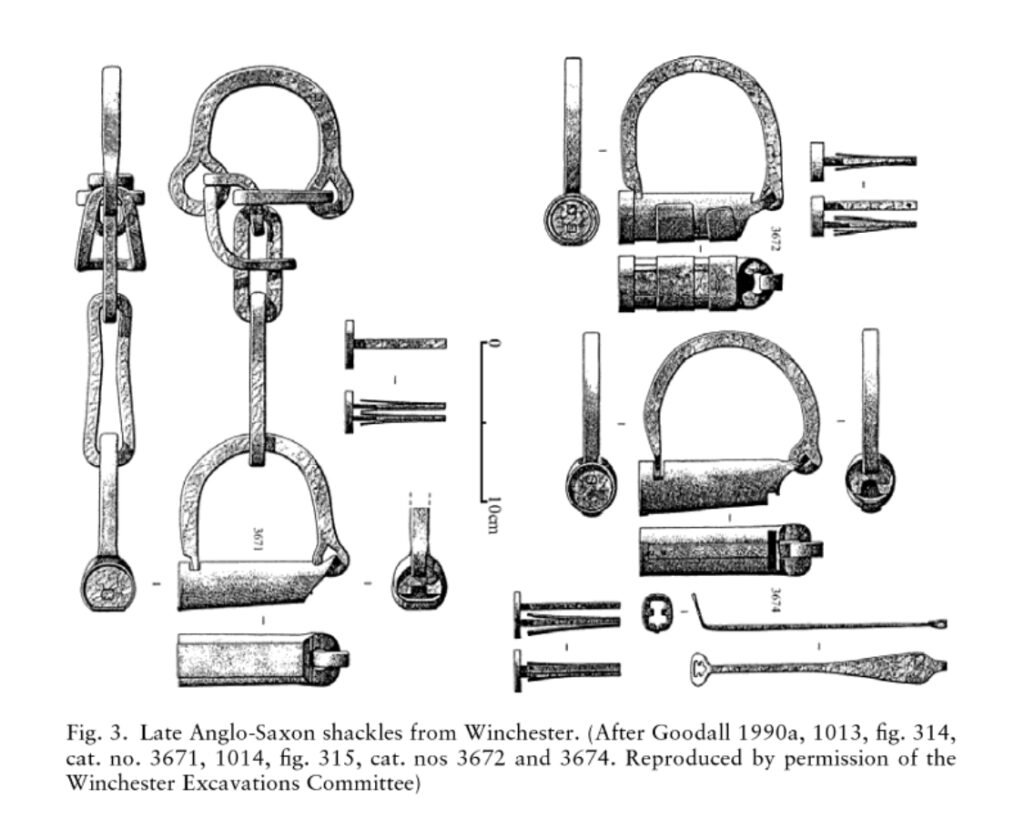
The only examples of iron shackles being found during the Anglo-Saxon period is given by Andrew Reynolds in his book Anglo-Saxon Deviant Burial Customs. These were discovered during archaeological excavations which took place at Winchester from 1961-1971, but not in a context with any skeletons:
A recent survey of Iron Age and Roman shackles included a consideration of post-Roman examples, with Winchester producing the only known finds of Anglo-Saxon date 4 … Late tenth- to late eleventh-century levels at the Old Minster produced two pairs of shackles and one single example, whereas eleventh-century levels associated with Houses IX and X at Lower Brook Street produced a single find … The context of the Old Minster finds is difficult to explain, although the structure would have been visited by those undergoing judicial ordeal. The Lower Book Street find is from a domestic context and is best viewed as a piece of scrap, given that only half a pair of shackles is represented.
Reynolds, Anglo-Saxon Deviant Burial Customs, page 15-16

Reynolds does give one example of a skeleton from the Anglo-Saxon period that was discovered bound with large iron bands, but this was in an early Christian monastic context:
A fifth- or sixth-century male skeleton from the early medieval monastic cemetery at Llandough (Glamorgan) was found with two iron bands around the waist, but as neither band confined the hands or arms, a penitential or medical motivation best explains these finds.
Reynolds, Anglo-Saxon Deviant Burial Customs, page 15
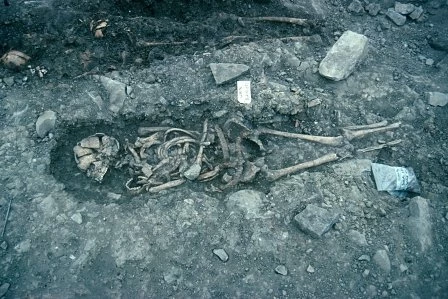
(Image from The Suffering of Burial 631)
The man was described as a “robust adult male, aged 25-35, and about 1.75 metres (5′ 7″) in height” who had a healed fractured rib. He had been buried with two separate, parallel bands of iron varying from 20 to 30 mm in width around his waist and no attempt appears to have been made to remove them before he was buried.
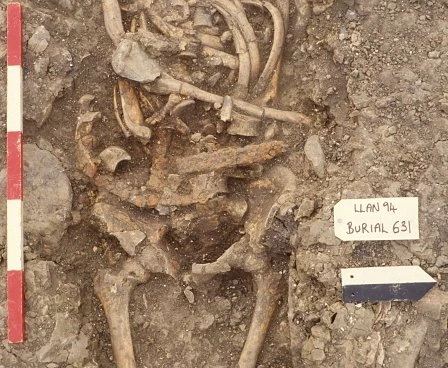
(Image from The Suffering of Burial 631)
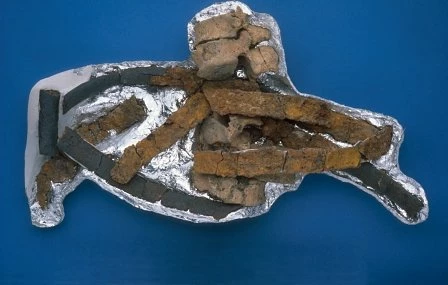
(Image from The Suffering of Burial 631)
The ends of the iron bands were secured behind the man’s back. Mark Redknap from the National Museum of Wales noted that the bands would have been impossible to remove by the monk who was wearing them:
The method of fastening the ends together was in both cases by means of a ‘hook’ forged out of one end and being passed upwards through a loop forged on the other, the point being bent over to secure the junction … a second person would have been needed to hammer the iron points over behind the wearer when putting them on, and similarly, someone would have needed to hammer the hooks open in order to release the bands from the body.
Mark Redknap, An Early Medieval Girdle from Burial 631, page 53-64, in An Early-medieval Monastic Cemetery at Llandough, Glamorgan: Excavations in 1994


He interpreted the bands as either being worn as a form of penance or a very rare example of an early medieval hernia belt. Impressions of textile, probably linen, were found on the surface of sections of the lower iron band showing an attempt had been made to reduce chafing, which he felt indicated that the medical interpretation may be the most likely of the two.
The only pre-Norman conquest example from Britain of a body being buried still wearing shackles comes from a Roman or immediately post-Roman context. Found at Great Casterton near Stamford, a man between 26 and 35 years old who was probably a slave was buried in a ditch sometime between 226 and 427 A.D. wearing heavy iron shackles and a padlock around his ankles.
The next example I have been able to find of the interment of a shackled body in England is not until 1139, when Bishop Roger of Salisbury and his retinue were taken into custody by King Stephen. Their bodies were buried in the cathedral at Old Sarum, Wiltshire. The body of Bishop Roger was exhumed and relocated to Salisbury Cathedral in 1226 but the other bodies were left behind during the old cathedral’s demolition. In 1913 an excavation of the east end of the cathedral discovered a set of leg shackles among skeletal remains. The remains are thought to be those of Roger le Poer, the Bishop’s son.5
In the early Anglo-Saxon period, after the collapse of the Roman Empire in Britain, iron was difficult to obtain and expensive to produce. Bog iron was the main source of iron ore and the smelting process was difficult and complex, as descriptions from the Thegns of Mercia and Regia Anglorum websites make clear. At that time, iron was valuable, as Dr Andrew Thompson notes in the ‘Thegns of Mercia’ article: “Due to the expense of producing it, there would have been a brisk trade in bar and scrap-iron.” Iron shackles could be re-used or re-forged and would have been very unlikely to be left on the corpse of a slave or an executed criminal.
Human Sacrifice?
If these shackles did come from the Greenbank site and were on a body buried there, then this fascinating lecture by Professor Ronald Hutton may give us another possible reason as to why they may have been left on the body after burial.
Now the bad news, the sinister stuff. There’s quite a bit of this. A quarter of all inhumations (that’s a lot) were buried with one body lying on top of another. Now in many cases this is fine, it may have been to indicate a family relationship, reuniting people intimately in the grave; but in nine well-scattered cases high status burials – rich people, female or male – were accompanied by a lower-status person put unceremoniously over or under them. In other words the rich person was laid out really carefully and had the goods, and then some unfortunate was thrown in either on top or thrown in and then the body laid out over them. At Welbeck Hill in Lincolnshire, a woman had been beheaded and buried over a man who had prestigious grave goods. At Portway in Hampshire, a man had been laid over a woman who had apparently been put into the grave with bound wrists. In four cases (this is where it gets really dreadful) it was actually suspected by archaeologists that people had been buried alive, but don’t worry – this is now disputed, as the bones were in all cases badly disarranged so that analysis is difficult. So you can believe the creepy interpretation if you like but you don’t have to. At Worthy Park, in Hampshire, a girl was thrown into a grave with both her wrists and her heels apparently tied together; so she could have been a human sacrifice or an executed criminal.
Most of the bodies which accompany other burials, in an apparently subservient relationship, are also face-down, and this is so rare in general (it’s 1 case in every 145 bodies) that it must be deliberate. It may have been to keep the person’s corpse or ghost from prowling and causing trouble – after all if you chuck them in unceremoniously you don’t want their ghost tapping you on the shoulder later and demanding an explanation or restitution, or it could have been to keep the spirit of the person in the grave to guard it and prevent it from being desecrated – so you are posting a sentinel there for good. Note folks, the modern East Anglian ghost stories of M. R. James stand in a very long tradition here of creepy guardian sentinels for burial places.
Professor Ronald Hutton, ‘Anglo-Saxon Pagan Gods’, Gresham College lecture, Wednesday 1st Feb 2023, transcript (30 mins,17 seconds from the start)
Could one of the people buried at the Greenbank cemetery have been the victim of human sacrifice?
The extremely poor recording of the Greenbank cemetery when the bodies were found in 1876 and 1877 means we don’t know whether any of the bodies there were buried with one lying on top of another or whether any were buried face-down (known as a ‘prone’ burial). However, it is worth noting that the Welbeck Hill Anglo-Saxon Cemetery in Lincolnshire6 mentioned by Ronald in his lecture, where a woman had been decapitated and buried above a man who had rich grave goods, is only around five miles away from the Anglo-Saxon cemetery at Fonaby which Roger Miket and Michael Pocock in their paper An Anglo-Saxon Cemetery at Greenbank, Darlington linked with Greenbank due to the striking similarities between the square headed brooches found at both sites.
It’s also worth noting that the pagan Anglo-Saxon cemetery at Norton in County Durham, just over ten miles away from Darlington and dated from around 550 AD to 620 AD and so contemporary with the Greenbank cemetery, contained a total of seven prone burials: “an unusually high number for any Anglo-Saxon cemetery”.7 One of the prone burials, grave 99 (below), was that of a female aged 17-25 years old with no grave goods apart from a comb, who was buried alongside but at a lower level to an older individual aged 20-30 whose grave goods implied was female. The younger, prone woman’s ankles appear to have been bound together with rope before she was unceremoniously thrown into the grave.

As with the cemetery at Fonaby, a square headed brooch was found at Norton which links the site to Darlington. Grave 22, that of a woman aged 25-35, contained a fine gilded example “which has many points of similarity to that from Fonaby and both of the Darlington brooches” ( An Anglo-Saxon cemetery at Norton, Cleveland, page 38).


Returning to Norton grave 99, the nearest comparison to this is what is probably the most famous of the supposed ‘live’ burials mentioned by Ronald in his lecture – graves 41 and 49 at Sewerby:
The closest parallel is provided by the Sewerby double grave 41 and 49 (Hirst 1985, 38-43), in which two women were buried one above the other in a single deep grave. In that case, however, the prone burial was the upper of the two
Stephen J. Sherlock & Martin G. Welch, An Anglo-Saxon cemetery at Norton, Cleveland, page 24
At Sewerby a woman aged 35-45 had apparently been thrown into a grave (grave 41) directly above the far more richly furnished and unusually deep burial of a young adult female aged 17-25 (grave 49). Both graves were probably contemporary and were dated to the second half of the sixth century
Of the older woman, Susan M. Hirst who excavated the site and authored the report, wrote:
The impression given by this skeleton at the time of excavation and subsequently is of a female fully dressed who was not dead when put into the grave … The position of the arms and legs suggests that after being pushed, put or dropped into the grave face downwards, the woman tried to force herself upon to her knees, but fell back with her lower legs and elbows bent up. She remained in this position and was perhaps prevented from further movement by the shovelling of soil on to her or the throwing of the piece of quern on to her back, or by her immediate death from one of these causes.
Susan M. Hirst, An Anglo-Saxon Inhumation Cemetery at Sewerby, East Yorkshire, page 39

Top image shows the grave during excavation, bottom image shows a reconstruction of the burial.
Hirst explored whether this might have been a sacrifice of a female slave, giving examples of human sacrifice in Scandinavia. But she also noted that the objects which accompanied the sprawled woman, including a knife, beads and a jet amulet, indicated that she was not a slave. Hurst suggested that the older woman may have caused the death of the younger woman through witchcraft and been buried alive as a punishment – a known sentence for witchcraft in Germany.
But, as noted above, no inhumation has so far been discovered during the Anglo-Saxon period wearing iron shackles – not even in ‘deviant burials’ such as these which could have been executions but might also have had a ritual, sacrificial element to them. It seemed that if a body was buried in the Greenbank cemetery wearing these iron bands then not only would it be a ‘deviant burial’, it would be unique.
But then I stumbled upon what must currently be the closest parallel to the ‘deviant’ Greenbank burial – another body that had been buried wearing not iron shackles, but two separate iron rings. Although this wasn’t from an Anglo-Saxon context but from a late fourth century Roman context, it may have been as little as 200 years before the Greenbank burial and was only 50 miles away in York.
The Gladiator Cemetery
In 2004 and 2005 the York Archaeological Trust carried out excavations in the back gardens of numbers 3 and 6 Driffield Terrace in York, about a kilometer south west of York city centre. There they found an unusual cemetery dating to the third and fourth centuries AD where 98% of the bodies were those of young adult males, some of whom who had come from outside Britain, including one who was of Middle Eastern descent from the area around modern Palestine, Jordan or Syria. Most of the males were taller than average when compared to adult males in Roman York or in Roman Britain as a whole. Over half of the bodies had been decapitated. Many of the men’s skeletons showed signs of blunt instrument violence with fractured skulls, bones and front teeth. Some of the bones also showed signs of damage from bladed weapons and one had a deep bite mark in his pelvis from a large carnivore such as a lion or a tiger. The cemetery was interpreted as being that of Roman gladiators.
In the back garden of number 6 Driffield Terrace was the burial of a young man aged between 26 and 35 years old. He had a fractured skull, damage to his right hand, a fractured left leg and had been decapitated. Around each of his ankles was a thick iron ring.
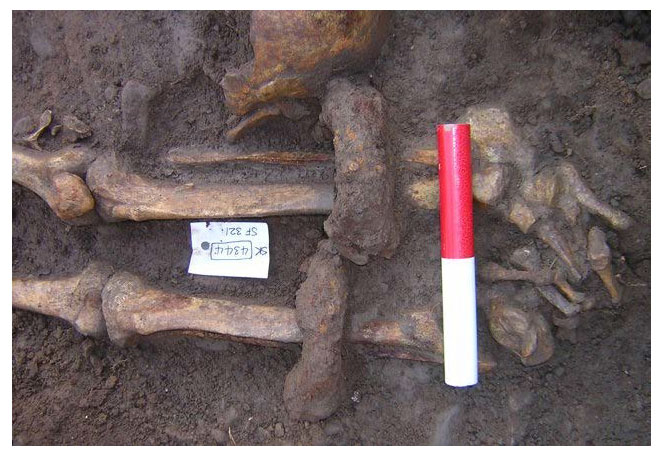

As this is the closest parallel to the two iron rings found at Greenbank it’s worth quoting at length from the excavation report:
At the outset it should be noted that these are not shackles in the strict sense. A large number of slave / prisoner shackles have been recovered from late Iron Age and Roman contexts across Europe … In all cases the shackle part consists of either two hinged segments that can be placed around the appropriate limb and locked into place, or a semi-circular element where the closing element is formed by the chain. In no case is the shackle simply a ring of iron that cannot be opened which was the case here.
The iron rings around the ankles of the Driffield Terrace body correspond to such fetters in only one respect, the internal diameter. It would not have been possible for feet to have been slipped through these rings. They would not have been effective as fetters because each foot was left free-moving. They are not joined together and show no traces of any attachments for chains. If they were to have been joined, a loose chain would have had to have been threaded through both rings and fastened in some way. Without such a chain it is difficult to see how escape could have been avoided. The rings are indeed heavy, but they are not so heavy as to immobilise an adult.
H.E.M. Cool, Selected Roman Small Finds from the Cemetery at nos. 3 and 6 Driffield Terrace, York, 2016, pages 4-6
The iron rings were X-rayed at the Royal Armouries Museum in Leeds.
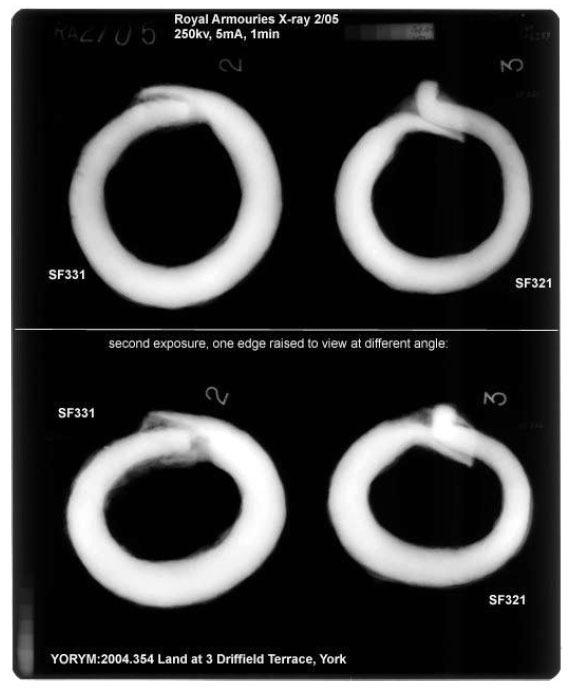
The leg irons are both round-sectioned iron bars, with one end beaten flat, and bent into a circle. SF331 which was found around the left ankle had the flattened end overlapping the blunt end on the exterior. SF321 from the right ankle had the flattened end on the interior and the end overlapping this and bent out at 900. The rings appear simply to have been forged to shape and the ends overlap rather than being welded closed. The bars were substantial. Measured from the X-radiograph, that around the left ankle (SF331) has section diameter of between 17.5 and 25mm, whilst that around the right ankle (SF321) had one of 15 – 23mm. The internal diameters (again measured from the X-radiograph) were 90 – 97mm and 82 – 89.5mm respectively. They weigh 1.871 kg and 1.440 kg.
H.E.M. Cool, Selected Roman Small Finds from the Cemetery at nos. 3 and 6 Driffield Terrace, York, 2016, pages 3-4
Roman London
Hilary Cool, the author of the York excavation report, noted that there were only two other instances of which she was aware of individuals being buried wearing separate iron leg rings which were not joined together as shackles. Both of these were inhumations from the upper Walbrook valley cemetery in Roman London and dated from AD 120-200. This is now where buildings on the north side of Finsbury Circus in the City of London are situated but in the second century AD it was marginal land to the north of the Roman fortifications crossed by several streams which fed into the River Walbrook, a tributary of the River Thames. The cemetery was poorly drained and prone to flooding and was set apart from the main Roman cemetery on both sides of Ermine Street, the northern road into Roman London. It’s thought that the upper Walbrook Valley cemetery was the burial site of some of the poorest people in Roman London. The meandering courses and seasonal flooding of the tributaries of the River Walbrook meant that many graves became eroded and some body parts became exposed after burial and even washed away into the river.
A disturbed adult burial (inhumation Bu73) in the waterlogged ground of a drainage ditch where just the lower legs survived was discovered with an iron leg ring above the left ankle. This was made from a thick square-sectioned iron bar and had an internal diameter of around 80mm, thickness 25mm, height 20mm and weighed around one kilo.
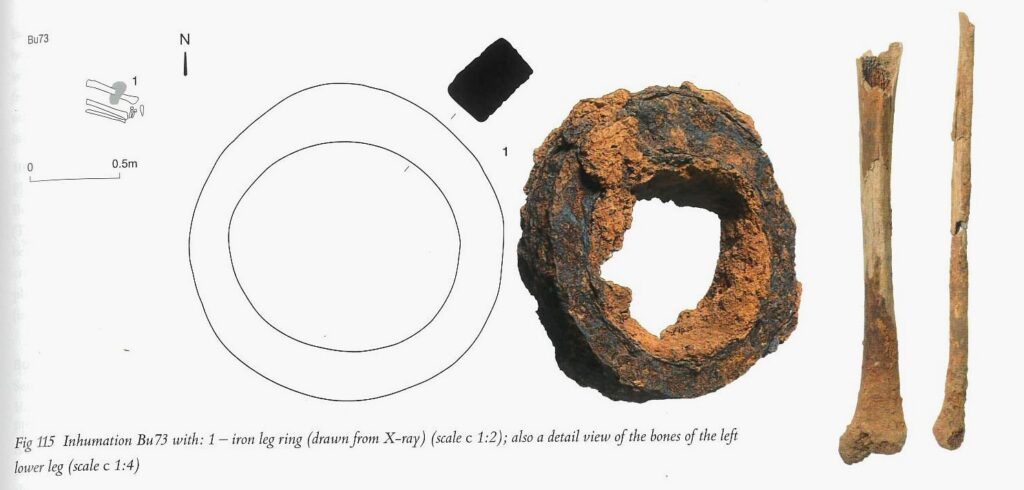
It was described in the report as:
Iron ring made from a thick bar, fitted on the left leg above the ankle. There are no clear details on the X-radiograph, which suggests an unbroken ring, but the striations in the metal itself appear to swirl as if coming to a terminal, and the image shows a thickening at this point, perhaps where the heated metal was hammered. It is unlikely that a ring of this internal diameter could have been slipped on or off a living foot with ease.
Chiz Harward, Natasha Powers and Sadie Watson, The Upper Walbrook Valley Cemetery of Roman London, 2015, page 148
Fifteen metres west of that burial and within the same ditch was the burial of a young adult male (inhumation Bu30), aged between 18 and 25 years old, lying on his back with his hands and lower arms beneath his pelvis. He had an iron ring around each of his lower legs. These were also made from bars of thick square-sectioned iron. Both rings were extensively corroded but had an internal diameter of approximately 100mm, thickness of 44mm and a height of about 50mm. They were not weighed due to the amount of corrosion.
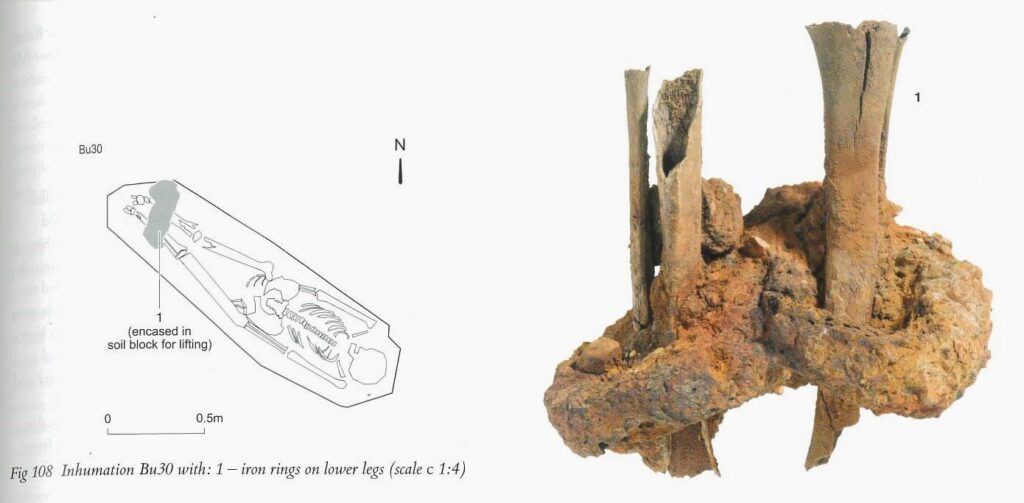
These rings were described in the report as:
Pair of heavy iron rings, each made from a thick, approximately square-sectioned bar, one ring around the lower part of each leg of the skeleton. Despite cleaning, it is not possible to see any welding marks, but it is assumed that the bars were heated and hammered into shape. There are no signs of any moveable fastening, so they cannot be classified as shackles or fetters, and it is not clear whether or not the rings could have been slipped over the feet of the living – or dead – person.
Chiz Harward, Natasha Powers and Sadie Watson, The Upper Walbrook Valley Cemetery of Roman London, 2015, page 144
All three of the iron rings were similar to the ones found on the skeleton at Driffield Terrace in York. They were solid rings with no apparent means of opening and no trace of any linking chain. Like the York rings, the diameter of these would have been too small to slip them over the foot of the adult wearing them. Once in place they would have been impossible to remove. Also like the York rings, the lower leg bones of the skeletons wearing them were apparently undamaged.
For the authors of the upper Walbrook Valley cemetery report, the significance of the leg irons was far from clear. In the case of the complete male skeleton his hands were positioned behind his back below his pelvis which could mean that they were bound, but if so this would not have been tightly. That the skeletons were wearing them could be seen as a sign of their status as a criminal or a slave, but as iron was of value in Roman Britain, they felt it was unlikely that they were wearing them in the grave as some form of punishment. They suggested that due to the value of iron the rings might even be seen as a mark of a higher status of the individuals wearing them than others buried nearby:
If the rings were fitted after death, one must consider whether this represents a ritual ‘shackling’ of the power of death or perhaps preventing a malevolent spirit or ghost from wandering the earth, or symbolise the status, possibly criminal or servile, of the deceased. In life or death, the wearing of leg irons might be seen as a punishment, or sign of servility, but it should also be borne in mind that iron was a valuable commodity which for most of the Roman period in Britain was regularly recycled, which perhaps argues against the individuals in question being ‘punished’ by the wearing of such items in the grave. The iron rings could, therefore, perhaps even be seen as a mark of higher status.
Chiz Harward, Natasha Powers and Sadie Watson, The Upper Walbrook Valley Cemetery of Roman London, 2015, page 95.
Returning to the York excavation report, again it is useful to quote at length from this as it has such relevance to the Greenbank case:
The leg rings at York and London pose considerable problems of interpretation. As they are not fetters in the normal sense of the word, it can be questioned whether they necessarily indicate that the men with them were slaves or prisoners; though the possible binding of the arms of one of the Walbrook bodies might suggest the latter status. Roman shackles are complex pieces of forging for a very good reason. The aim was to keep the individual secure but not to kill them. The shackles may have been uncomfortable to wear, but they would not have been harmful other than superficial sores and abrasions. The smaller rings at both London and York would have been too small to have been forced over a living adult foot and ankle, and it would have been difficult to have to have done that with the larger ones. The alternative would be to forge them in place. The injuries associated with putting these rings onto a living person would have been dreadful. Each substantial bar would have had to be heated to red heat and though it would have been possible to forge it to a U-shape away from the person, each end would have had to be hammered closed around the ankle. An eminent consultant physician has described such an activity as likely to cause ‘the most horrific damage, including most likely fractures and severe burns’ (T. Waldron pers comm.). It is unlikely that anyone would survive such an operation. When the bones of the York individual were studied initially, it was suggested that the areas of porous woven bone seen on the legs are the result of the individual having been shackled for some time. If this is correct it seems highly unlikely that it could have been as the result of these rings. The various factors would seem to suggest that the rings were forged around the ankles of a dead body, and the question then arises – why? It could have been to suggest a servile condition, but in that case it seems a great deal of effort when it would have been easier to use a set of proper fetters. One possibility is that it was done to stop the deceased walking as a ghost amongst the living though, given that the York man was accompanied by hobnailed shoes, there must be assumption that he was free to continue his journey to the afterlife. A third possibility, strange as it might seem, is that it might just have been a mark of distinction … During much of the Roman period iron had been a common material, but in the fourth century iron artefacts start to be deposited again as hoards, just as they had been in the late prehistoric period. People were regarding iron differently, and any individual treated as this one has been could well have been regarded as special in some way. We can only speculate why this man should have gone to his grave wearing these monstrous rings, but there are sufficient oddities about them that the assumption that they indicate he was a slave or a criminal should not be made unthinkingly.
H.E.M. Cool, Selected Roman Small Finds from the Cemetery at nos. 3 and 6 Driffield Terrace, York, 2016, pages 6-7
So could my initial assumption that one of the bodies from the early Anglo-Saxon cemetery at Greenbank was buried wearing shackles which have subsequently broken have been incorrect? Could the Greenbank burial be a new case, this time in an early Anglo-Saxon context instead of a Romano-British one, of a body being buried wearing a separate, iron ring on each leg which were never joined together into fetters?
The Greenbank rings are different from the three Romano-British ones above though – with an internal diameter of 73-75mm they are at least 5mm smaller in diameter than any of the three Romano-British ones, and with a width of 3mm and a height of 10mm they are considerably thinner, narrower and lighter. Plus it appears that they somehow ‘hooked’ together rather than being hammered into a completely closed ring.
But similarly they would have been extremely difficult to get on to a living person’s ankles and extremely difficult for the person to have removed them. Could the Greenbank rings have been forged around a live person? At around 1,400 degrees Fahrenheit, if it did not kill them from burns, shock or infection it would certainly severely maim them. None of the three examples has damage to the bone suggesting this though. Wrought iron could be hammered and shaped cold by a skilled blacksmith, but even this would have caused considerable pain and bruising. As the author of the York report says, why would you do this when you could use fetters? In both the York and the Walbrook cases the archaeologists have come to the conclusion that the iron leg rings must have been fitted after death. Why would someone forge iron rings around a dead body?
The argument that these rings indicate some kind of higher status or a mark of distinction because iron was quite a valuable commodity simply isn’t convincing. Having large chunks of red hot iron hammered around a dead family member, friend or comrade’s ankles is clearly not respecting or honouring them. It is a clear and obvious violation of the body – and just imagine the stench. Hilary Cool, the author of the York report, herself describes these rings as “monstrous” (page 7).
The most convincing, and strangest, theory is the one that is given the shortest shrift in both the York and the London reports – that these rings were fitted to the dead body to somehow stop the ghost of the deceased person from ‘walking’. My gut instinct told me that this might be relevant to the Darlington case, but both of these examples were from a Roman context and nothing similar had been found at all from the early Anglo-Saxon period. Again it seemed that I had reached a dead-end.
The ‘Dangerous Dead’?
Then I chanced upon a short paper written by archaeologist Matthew Beresford in 2012 entitled The Dangerous Dead: The Early Medieval Deviant Burial at Southwell, Nottinghamshire in a wider context (this doesn’t seem to open properly on mobile devices but does seem to open OK on PCs). In it he described an excavation carried out in 1959 by Charles Daniels8 on the site of a large Roman villa located to the south east of Southwell Minster, and in particular a burial dated to the sixth century CE. What Daniels discovered is biggest clue I have found so far for the use of the iron shackles or rings in the Greenbank burial.
Matthew Beresford takes up the story:
When Daniels excavated part of the South Wing of the Roman villa (his trench 6) he discovered the remains of later Saxon burials, of which he found thirty in the areas of rooms one and six of the villa. These were intact Christian burials (aligned east-west) or remains that had been disturbed by later ones. Trench 2, which was further to the east … revealed an altogether different picture. Here two thin, diagonal trenches had been dug that cut across Roman features, and into these the disarticulated remains of several individuals had been deposited (Daniels claims at least a dozen), with one exception. This was the deviant burial which had been buried (or reburied) intact along with a further leg and lower arm bone.
What Daniels discovered was … to paraphrase Dr. John Blair, one of the ‘dangerous dead’ (Blair, 2009), because the remains had been ritually staked, with iron nails piercing the shoulders, heart and ankles …
Matthew Beresford, The Dangerous Dead: The Early Medieval Deviant Burial at Southwell, Nottinghamshire in a wider context, 2012, pages 1-3


Daniels, Beresford noted, commented in his 1965 excavation report that he was unable to remove the iron nail hammered into the body’s right shoulder so perhaps the skeleton remains in the ground there to this day? The story was picked up by the Daily Mail soon after the publication of the report in 2012, which announced Rare skeleton of ‘vampire’ discovered in Britain with spikes through shoulders, heart and ankles.
What the Southwell burial appears to be is a body which has been ‘disabled’ to stop it returning from the dead and becoming a revenant – an animated corpse that would bring disease and death to the living.
John Blair in his chapter The Dangerous Dead in Early Medieval England (quoted by Matthew Beresford) from the 2009 book Early Medieval Studies in Memory of Patrick Wormald, argues that fear of the undead goes back into pre-Christian English culture, clearly shown by:
the mounting evidence from sixth- to seventh-century cemeteries for the deliberate disablement of corpses in precisely the ways that would later be employed by East European vampire-slayers … It is hard to find alternative explanations for binding or mutilating the lower limbs …
John Blair, The Dangerous Dead in Early Medieval England, page 542 (my emphasis)
Blair gives another example of one of the even rarer burials in England where iron has been used to immobilize a corpse:
a sixth-century burial at Harwell (Berks.) where a spear was driven through the heart and left protruding from the body as it lay in the grave …
John Blair, The Dangerous Dead in Early Medieval England, page 542
In the summer of 1966 a Mr. R. L. Otlett was digging a drainage ditch in the garden of his bungalow ‘Downscroft’, The Hollow Way, Harwell in Oxfordshire and discovered part of a skeleton. He was aware from the previous owner that there had been an archaeological excavation in the garden of the bungalow eleven years earlier in October 1955. This had been carried out by a Mr. and Mrs. K. Marshall on behalf of the Ashmolean Museum and six early Anglo-Saxon graves had been discovered. Mr. Otlett contacted the museum to inform them of the new find.
A Mr. P. D. C. Brown from the Ashmolean Museum and the Committee of the The Oxfordshire Architectural and Historical Society, together with Mr. Otlett and some of his neighbours, excavated the location where the latest skeleton had been found.

The skeleton, which appeared to be male and under 30 years of age, was interred on its back with its head to the west, in a similar fashion to the six graves found previously. However, as P. D. C. (David) Brown notes, “the only object found with the burial was a spearhead. It was deeply embedded in the left side of the skeleton.”

the spearhead would appear to have entered on a level with the top of the heart, at a point close to the left nipple, and passed inwards to lodge against the backbone. Such a course would have taken it directly through the heart.
Report on the skeleton by Mr. H. Carter of Reading Museum, in P. D. C. Brown, The Anglo-Saxon Cemetery at Harwell, Grave 7, Oxoniensia Volume 32, page 73
Brown goes on to note:
There seems to be no doubt that the spear thrust caused this man’s death. It is worth noticing that here is a man killed by an Anglo-Saxon spear, and buried in an Anglo-Saxon cemetery.
P. D. C. Brown, The Anglo-Saxon Cemetery at Harwell, Grave 7, Oxoniensia Volume 32, page 74
Sam Lucy in her book The Anglo-Saxon Way of Death: Burial Rights in Early England echoes this and notes this has “interesting implications” (page 69).
Mr. H. Carter from Reading Museum believed that the spear that killed the man had been left in the body even after burial because:
of the difficulty of extracting it after it had passed twice through the rib-cage and entered the dense mass of muscle and tendon which lies behind and beside the vertebrae. If the haft snapped or pulled out from the socket, very little of the metal would be left exposed, and its extraction would then be impossible without dismembering the corpse.
Report on the skeleton by Mr. H. Carter of Reading Museum, in P. D. C. Brown, The Anglo-Saxon Cemetery at Harwell, Grave 7, Oxoniensia Volume 32, page 73
John Blair however argued that:
Given that the socket of the spear-head must have projected well outside the body, and that it still contained mineralized wood from the shaft, the excavator’s view that the weapon had been left in place after a fatal encounter seems implausible.
and provided his own diagram:

Surprisingly, there is no comment from either P. D. C. Brown or John Blair about the previous excavation, for which the report – ‘A Saxon Cemetery near the Village of Harwell, Berkshire’ – was published in Oxoniensia Volume 21 in 1956. It seems that grave 7 may not have been the only example in that cemetery of a spear being driven into a corpse and left sticking out of the ground9.
The body in grave 1, to the south, was the lower one in a double grave. The body above had been badly damaged by a previous drainage trench that workmen had been digging before they discovered an Anglo-Saxon food or drink vessel which had been placed in the grave. The lower body was on its back in an extended supine position:
In the earth immediately above the centre of the body were an iron knife and a small, bronze buckle. An iron javelin-head was also found, in a line with which, westwards, faint traces of wood were seen reaching downwards at an acute angle to the horizontal for a distance of 5½ feet. A small gilt-bronze square-headed brooch was found above the left clavicle, and above the fourth cervical vertebra was a bronze applied-brooch.
Joan R. Kirk and Kenneth Marshall, A Saxon Cemetery near the Village of Harwell, Berkshire, Oxoniensia Volume 21, page 26 (my emphasis)
The grave goods suggest that the body was female and the grave seems to be conventional and fairly well-furnished. The iron javelin-head was apparently found by the right hip of the body according to the rudimentary sketch of the double burial in the plan of the graves, but the acute angle of the shaft suggests that it wasn’t laid next to her as a grave good but was driven from a position behind the head either into the right hand side of the body itself to pin it down or into the ground next to it as some form of barrier. Of course as it was a double burial of one body above another it is perfectly possible the thrust was intended for the upper body, of which the sex is unknown as so much of the skeleton was destroyed.
The iron javelin-head was almost seven inches (17.6 cm) in length and was described as:
unusual in shape for an Anglo-Saxon spear-head, and, in fact, resembles more closely a Roman pilum … Other objects from the same grave, however, would imply that it may not be earlier than the sixth century.
Joan R. Kirk and Kenneth Marshall, A Saxon Cemetery near the Village of Harwell, Berkshire, Oxoniensia Volume 21, page 28
It is illustrated (object ‘b’) in the image below:

The javelin-head was donated to the Ashmolean Museum in 1955 by a Mr. R. Gregory, the owner of the bungalow in 1955, and there is an image of it on their website:

In the photograph above the tip seems to be more of a pyramid shape than the drawing from the excavation report suggests, supporting the observation that it has a closer resemblance to a Roman pilum, which had a pyramidal head, rather than the broader and flatter early Anglo-Saxon thrusting spear. The narrowness resembles a spike, designed to penetrate deeply. The ability of a pilum to penetrate a shield is demonstrated very effectively by Mike Loades in this video:
For Blair:
there is compelling evidence that Anglo-Saxon England was one of those societies that identified a minority of special individuals among the dead as hard to keep in their graves.
John Blair, The Dangerous Dead in Early Medieval England, page 542-543
In the 2015 documentary Secrets of the Dead: Vampire Legend John Blair explores the subject of the ‘dangerous dead’ of the Anglo-Saxon period further:
The Southwell burial and the two Harwell burials are the only other early Anglo-Saxon burials I have discovered which appear to involve the use of iron to ‘disable’ a corpse. Could one of the people buried at the Greenbank cemetery in Darlington have also been thought likely to return, or even actually have come back, as one of the ‘dangerous dead’?
A ‘Bad’ Death
What could have caused people to believe that someone in their community was likely to return after death as a revenant? Nancy Mandeville Caciola in her paper ‘Wraiths, Revenants, and Ritual in Medieval Culture’ identifies those who had either lived a ‘bad’ life or who had a ‘bad’ death (page 27). Someone was likely to become a revenant if they had had an malicious and aggressive nature. But even if someone had been a good person in life if they had met with a sudden or violent death this would also put them in danger of becoming a revenant. If both was the case then the danger was even more pronounced.
The underlying logic of belief in revenants is that of a remaining life-force in the bodies of those who projected strong ill will, or who died too suddenly, leaving “energy still unexpended”
Nancy Mandeville Caciola ‘Wraiths, Revenants, and Ritual in Medieval Culture’ page 29
‘Cunning’ Women
Alongside people who had lived a ‘bad’ life and / or had a ‘bad’ death, individuals viewed as powerful when alive could also be feared as potential revenants after death. Among such individuals were witches or ‘cunning women’ who were seers and healers in Anglo-Saxon communities:
Witches could be viewed both positively and negatively in the pagan and Christian periods. Examples of ‘cunning women’ buried utilizing deviant rites … support the view that such women were viewed in superstitious terms as powerful individuals in death as well as in life.
Andrew Reynolds, Anglo Saxon Deviant Burial Customs, page 90, authors emphasis,
Audrey Meaney in her beautifully illustrated 1981 book Anglo-Saxon Amulets and Curing Stones identified a wide variety of unusual, non-utilitarian, ‘odd’ objects found in early Anglo-Saxon graves that could be considered to be magical amulets. She believed that collections of such objects could identify graves belonging to ‘cunning women’. One of the most famous examples of a grave thought to be that of a ‘cunning woman’ was found at Bidford on Avon, Warwickshire. The grave contained twelve miniature bronze ‘bucket’ pendants and a bronze disc shaped pendant which had been fastened onto a leather bib that the woman had worn around her neck and over her chest. She also had a bag by her left hip which contained a variety of objects including the tip of a deer antler, plus a knife that had been suspended from her belt which resembled a scalpel.10

A more recent find of possible ‘cunning woman’ burials was at Scremby near Skegness in Lincolnshire. Grave 17 was that of an adult female and contained a necklace of bucket pendants plus a necklace of beads with a central beaver tooth pendant. A chalk spindle whorl which may also have been an amulet was placed next to her right foot. An ivory-ring bag containing a 10 cm long iron rod was by her left hip.

Grave 12 from Scremby was also that of an adult female and also contained an ivory-ring bag in which were small objects that could have been amulets including a bronze mount with repoussé decoration, a pair of girdle hangers and a 12 cm iron rod.11


Image: The Guardian, where it can be seen in larger resolution.
‘Deviant’ Burials of ‘Cunning Women’?
These graves were all conventional supine burials and richly furnished with grave goods. There were no ‘deviant’ aspects to their burials and nothing to suggest that they had been suspected of potentially or actually returning from the dead as revenants. However, Andrew Reynolds in his book Anglo Saxon Deviant Burial Customs gives examples of some ‘deviant’ burials that were possibly those of witches or ‘cunning women’.
Reynolds identified a number of burials of women, almost all buried face down and one where stones were also placed on her body, who were accompanied by ‘amuletic objects’ such as beaver-toothed pendants (similar to the one round the neck of the woman at Scremby), who he considered may be “powerful individuals in death as well as in life.” (page 90).
Two interesting examples came from West Heslerton in North Yorkshire. This was one of the cemeteries which featured in the Secrets of the Dead documentary (above). Out of 185 inhumations discovered there, at least 12 or 7% were prone – so making it, according to archaeologists Christine Haughton and Dominic Powlesland who excavated it, “a veritable den of witches if we are to accept this interpretation.” (Volume 1, page 92).
Grave 113 was that of an adult woman aged around 20. It was cut deep into the ditch of a late neolithic / early bronze age henge. It contained high-status grave goods including a number of amulets. There were 2 large and 55 small amber beads, a silver bead, a silver ring, an iron pendant and a beaver-tooth encased in a copper alloy mount, plus a leather purse or pouch which contained iron latch lifters and a pair of copper alloy girdle hangers. Haughton and Powlesland identified this as a possible ‘live’ burial similar to the one at Sewerby due to the twisted positioning of the body.

Grave 132 contained a the body of a young woman aged between 15 and 20 and this was one of the bodies featured in Secrets of the Dead. Her legs had been broken by being forced upwards towards her pelvis and may have been bound at the ankles. Accompanying her were two annular brooches, a necklace of glass and amber beads plus a jet disk bead and a cylindrical chalk bead and latch lifters in a textile purse. Intriguingly there had also been a wooden cup bound at the rim with a copper alloy band placed by her head, which had been filled with brassica seeds.


Both bodies were accompanied by a curious amulet – a walnut had been encased in a cradle of copper-alloy bands. The one from grave 113 had a ring at the top and could have been worn suspended from a girdle, but was found in the leather pouch.

The one from grave 132 was in a textile purse and is illustrated (bottom of image) with the fragments of this.

Both walnut amulets had two triangular ‘spangle’ pendants (delightfully known as ‘klapperschmuck‘) at the bottom which, if they were suspended, would have dangled and jangled as the wearer walked.
Could both of these young women have been ‘cunning women’, perhaps ones known in their community for practicing sorcery and harmful magic instead of the more beneficial healing kind and so suspected of being prime candidates to return as a revenant, which was why they were buried in this manner?
In Anglo-Saxon Amulets and Curing Stones Audrey Meaney mentions that one of the Greenbank burials contained what may have been an amulet:
In a cemetery of the mid sixth century or later at Darlington, Durham, ‘a chalk object, perhaps a spindle whorl’ was at the neck of one of the bodies.
Meaney, Anglo-Saxon Amulets and Curing Stones, page 96
This is the “chalk talisman or charm which may have been round the neck of one of the skeletons” described by J. T. Abbott in his letter to The North Eastern Independent on 1st February 1879. The burial of the possible ‘cunning woman’ in Grave 17 Scremby also contained a chalk spindle whorl. Meaney notes that a large cylindrical chalk bead was found in a child’s grave in Kent and that the Anglo-Saxons connected chalk with the protection of children. Chalk or a chalk-like substance was also used for some ‘sword-beads‘ – a large amulet fastened to a scabbard. She notes that the use of chalk, gypsum or any soft ‘white material’ is “too soft to withstand any kind of pressure …” and “Whatever caused the use of ‘white material’ for sword-beads – or indeed, for hanging round children’s necks – must have been magically very powerful, to compensate for this impracticability.” (page 96-98)
Meaney also went on to refer to the ‘stone beads’ found at Darlington – these are the beads listed by J. T. Abbott as being part of the “large necklace, composed of amber, glass and stone beads” which after its sale at Sotheby’s in 1888 is now lost. Meaney, noting that the beads are “not described in the sources”, mentions them in the context of naturally perforated pebbles known ‘hag stones’ being used as beads. Such stones, she writes, have “something mysterious about them” and possibly protected people against nightmares and witchcraft and to were used to cure ‘elf-shot’ humans and cattle (page 99-100). Amber, according to Meaney, may have had curative and protective magical powers for the Anglo-Saxons. Its use for supernatural purposes is suggested due to its explicit condemnation by early Christian church leaders such as in the sixth century sermons of Caesarius of Arles:
If you still see men . . . hanging devilish phylacteries, magic signs, herbs, or [amber] charms on themselves or their family, rebuke them harshly.
Do not hang on yourself and your family diabolical phylacteries, magic letters, amber charms and herbs.
Let no-one in any sickness dare to summon or question sorcerers or seers or magicians in wicked pleasure. No-one should hang phylacteries or charms on themselves or their possessions.Valerie I. J. Flint, The Rise of Magic in Early Medieval Europe, page 245
Iron Rods
Alongside these possible amulets of chalk, stone and amber, an ‘iron rod’, similar to the two found at Scremby in the ‘cunning woman’ burials, is listed amongst the objects found at Greenbank once owned by Canon Greenwell and now held by the British Museum (museum number OA.4934). Initially I thought this may have been part of the iron ‘shackles’ that had broken off, but its description does sound very similar to the iron rods found within the high-status ivory ring-bags of Grave 17 and Grave 12 at Scremby. The bag in Grave 17 seems to have held only an iron rod, which was 10cm long, while the bag in Grave 12 held a 12cm long iron rod alongside a small amulet, a knife and a pair of girdle hangers. The iron rod found at Greenbank was a similar length to these, being 13.45cm long. It is described on the British Museum website as being “of rectangular section, tapering to a point at one end”. The Scremby article does not give any further details of the iron rods found there apart from their lengths12 but the tapering to a point of the Greenbank rod (if deliberate and not the result of the rod being broken off a larger iron object) might suggest some kind of tool or implement. Returning to Scremby, ivory-ring bags held women’s most precious and often magical possessions. It is not clear what might have been magical about an iron rod, but perhaps it was some kind of instrument used by cunning women?
Could there be a connection between the small iron rods found at Greenbank and Scremby and the much larger and very rare magical iron staffs that have been found in ninth and tenth century graves of some high status women in Scandinavia?13

Could there also be a relationship with miniature staffs made of copper alloy or silver as well as iron, which were attached to rings and used as amulets and also found in some women’s graves in Scandinavia?14

Both these large and small staffs have been linked with the magical practice of seiðr and the Norse god Óðinn.
Roberta Gilchrist in her paper Magic for the Dead? The Archaeology of Magic in Later Medieval Burials has written about wooden rods that were placed into graves in some British monastic and also parish church cemeteries from the 11th to the 15th century. These rods varied from 25 cm to almost 2 metres in length and appear to have been made specifically for this purpose.
I suggest that the rods may be an example of the hybridity of Christian burial customs with earlier magic.
Gilchrist, Magic For the Dead? page 127
Could they also be linked with iron rods from earlier, pagan Anglo-Saxon graves?15
‘Death Midwives’?
In her paper ‘The Control of Burial Practice in Anglo-Saxon England‘, Helen Geake warns that:
Identifying ‘cunning women’ graves as those of ritual specialists on the grounds of their grave-goods alone is risky, as almost every type of Anglo-Saxon female grave-good has, at one time or another, been identified as possessing amuletic or magical significance … Because of this, all those buried (for whatever reason) with many objects begin to look like jingling, glittering magicians. Case studies must, therefore, concentrate on examples of women who look, in death, so unlike the majority that we are forced to interpret them as something out of the ordinary.
Helen Geake, The Control of Burial Practice in Anglo-Saxon England, page 263
Geake suggests that such women as well as being pagan ritual specialists, healers and fortune tellers may also have been the controllers and managers of burials in their communities, ensuring that the correct burial customs and rituals were observed – a role that she describes as that of ‘death midwives’ (page 264).
We don’t know for certain if the body wearing the ‘iron bands’ found at the Greenbank cemetery was female, but their dimensions do seem to correspond more closely to the size of the average female body than that of the average male. Their presence in a grave certainly marks that grave as something very ‘out of the ordinary’, over and above the presence of the chalk amulet, the stone (possibly hagstone), glass and amber beads and the iron rod.
If a ‘cunning woman’ who also acted as a ‘death midwife’ for the small community – possibly just a single extended family – that was buried there, a woman who had the power to move between the world of the living and the world of the dead to ensure the smooth and safe transition from one to another, then would she not be a prime candidate to be considered as someone who could possibly return from the dead as a revenant to cause trouble and harm to her family – one of the ‘dangerous dead’ who needed to be controlled and restrained in order to be kept in her grave?
Killing the Dead
John Blair’s book Killing The Dead was published in September 2025 and in it he expanded on what he explored in his earlier ‘The Dangerous Dead in Early Medieval England’ book chapter to examine the phenomena of vampire epidemics and corpse killing across much of the world.
In the chapters on early medieval England he compared the different treatment of the dead in the sixth century with that of the seventh using some of the examples of deviant burials I’ve cited above such as West Heslerton in North Yorkshire, Sewerby in East Yorkshire and Norton in County Durham, plus some others.
In both centuries the dead who had been buried in an unusual, so-called ‘deviant’, manner were predominantly women, which he argued must surely have been a deliberate bias. In the seventh century these women had initially been given a normal burial but then subsequently violently attacked and mutilated weeks or months later when they were in a semi-decomposed state. But in the sixth although they had been deliberately treated in strange and unusual ways at burial to ‘disable’ them they had then been left alone:
These abnormal sixth-century female graves differ from their seventh-century successors in that they do not show disturbance or mutilation after burial. Maybe people held these women in awe while they lived, and knew that they had to be treated appropriately after death. We need not infer that they were thought evil, or that the treatment was shaming, but they were reservoirs of supernatural energy. Some of that energy remained in their corpses and had to be controlled. The details are irrecoverable, but it is a reasonable conjecture that these distinctive and theatrical funeral rites were designed both to appease them and to discourage them from returning. After that, they were not disturbed again.
John Blair, Killing The Dead, page 191
So why was this? In both centuries Blair argues that the responses to the dead was a reaction to upheavals, stresses, disasters, trauma and epidemics of disease such as the bubonic plague.
In the pagan era of the 5th and 6th centuries some women held high status as powerful ritual and magical specialists – today we might describe them as ‘witches’ or perhaps as ‘cunning women’ or ‘wise women’, but Blair invites us to think about other names they may have been given at the time, vibrating with a sense of their formidable skill and power:
Old English words for female magical practitioners and supernatural beings are helpful here. Inevitably we only know them from later (strongly negative) references, but hægtesse, helrune, heahrune, and burgrune all plausibly refer to powerful women skilled in mysteries, with a certain ambiguity about whether they were this-worldly or other-worldly: maybe they were adept at crossing that frontier. This is a far richer vocabulary than anything ascribed to male practitioners …
John Blair, Killing The Dead, page 187
These women were potentially dangerous, they were feared but also respected and maybe even revered by their families and communities. Once dead they had to be controlled “to keep their dangerous life energies in check” (Killing The Dead, page 199) which led to such carefully staged theatrical positioning of corpses creating such strange funeral tableaux.
But as Anglo-Saxon England converted to Christianity in the 7th century, such women’s traditional authority was heavily diminished. Women who were previously seen as spiritually powerful became loathed as evil and demonic, making recently dead women the targets of violent mutilation or “corpse-killing” rituals to neutralise their perceived threat.
In this interview from 30th October 2025 John Blair notes that these strange burials of sixth century female magical practitioners are mainly found in north east England, including in County Durham:
So the earliest European cases that we know are from England, a few from the Rhineland. The English ones are best studied, and they fall into two groups, which are partly reflections of patterns in grave good deposition which is … which causes difficulties because people may have been doing things but at times they weren’t using grave goods so it’s harder to date the burials, but the first is between about 560-580 on grave good evidence, and these are in north east England – they’re in Yorkshire and County Durham. They’re all female and they are mostly women accompanied by things like symbolic keys, amulets, magical equipment – and the extraordinary thing about these is the weird positions they are placed in. They are face-down, some of them seem to have been over something like a wooden chest that’s collapsed, sometimes their legs are tied back and the most extraordinary thing is that in almost every case one limb – it’s either a leg or an arm – is raised up so it’s almost touching the surface of the grave. You can’t do that accidentally when you are burying a body you can’t have a hand coming up and almost touching the surface without meaning to do that so it’s obviously meaning something. I think these must from their equipment be wise women. What’s notable in these cases is that they are not disturbed afterwards, they are buried first time round like this. So when they die people say OK you know, she’s important, she’s done good, but now we’ve got to keep her under control that’s how I would interpret it. So those are the sixth century ones.
During the course of my research into the “iron bracelets” found at the Greenbank cemetery in Darlington I have gone from initially thinking that one of the bodies there must have been a victim of human sacrifice, possibly a slave, to now being convinced that we might have found a female magical practitioner – a helrune – amongst the forgotten Anglo-Saxon dead of Darlington, one who was so powerful that the only way her extended family could conceive of controlling her after death was to bind her with bands of iron.
One of the things we do know is that the skeletons of the bodies found at Greenbank were probably re-buried close to where they were discovered. According to J. T. Abbott in his letter to The North Eastern Independent newspaper published on Saturday 1st February 1879, “The skeletons were left in the ground except the skulls.” Now, in the 21st Century, in an age of painstaking archaeological excavations and the careful storage of finds, this seems astonishing. But removing the skulls of human skeletons and then just covering over the bones again was quite a common practice back in the nineteenth century.16 If there was a body buried wearing iron shackles, a body suspected by those who buried her of being likely to return from the dead to threaten and even kill the living, her bones are probably still lying in the dark earth beneath the Victorian scoria brick or beneath the modern tarmac close to the junction of Dodds Street and Selbourne Terrace. But the iron shackles intended to keep her from coming back are now over two hundred miles away in Oxford, in a glass case in the Ashmolean Museum…
I have passed by this place several times a week, sometimes quite late at night, for the past quarter of a century. Dodds Street, apart from once having an exceptionally good Chinese takeaway (R.I.P. Chef Paul), has always felt to me like any other ordinary street in the area.
But whenever I have passed by the narrow wooded area at the southern tip of the triangle of land where Greenbank hospital once was (now Greenbank Court) at dusk or late at night I have often felt some kind of a ‘presence’. For a long time I just assumed this was because I was born on this spot, at Greenbank maternity hospital, and so naturally had a connection with the land there.


I’ve never felt threatened by it, even late at night. In fact, in the peace and silence around midnight is when it feels strongest and most communicative. It’s always felt like a powerful male presence to me, a kind of guardian energy. Now that I know the story of the pagan Anglo-Saxon burials – our ancestors of place, the first known inhabitants of Darlington – perhaps it could be the ghost of Deornoth or whichever chieftain was buried there with his seax, spear and shield and whose bones lie there still?
But to me it feels even more powerful than that. Perhaps it could even be the presence of the Anglo-Saxon god Woden, guarding the graves of those who once worshipped him – and perhaps especially the grave of a woman who may have called upon him to work her powerful and terrible magic?
Footnotes:
1 A pair of actual Anglo-Saxon bracelets were found at Norton and look very different. They can be seen here.
2 Average wrist size for women and men based on the body measurements of a sample of US male and female military personnel taken in 1995 (women) and 2017 (men).
3 Average ankle size and circumference for women and men based on the body measurements of a sample of US male and female military personnel taken in 1988.
4 Hugh Thompson, ‘Iron Age and Roman Slave-Shackles’, Archaeological Journal, Volume 150, 1993, pages 57-168.
5 Alex Langlands, ‘Three Sets of Shackles at Old Sarum, the “Arrest of the Bishops” in 1139 and the Power of Shaming in the Anglo-Norman World’, The Antiquaries Journal Volume 103, 2023, pages 195-214.
6 Welbeck Hill early Anglo-Saxon cemetery was excavated by amateur archaeologist Gordon Taylor, a history teacher from Cleethorpes, between 1962 and 1979. Seventy two inhumations and five cremations were recorded. Grave goods included cruciform, square headed, small-long and annular brooches, sleeve clasps, girdle hangers, beads, silver bracteates, knives and spearheads, all dating to the mid 5th to late 6th centuries. The decapitated female buried over a man with rich grave goods was the female in Grave 12 at the cemetery. Taylor died in 2017 and his widow put his entire collection of artefacts from the site up for auction. This caused a great deal of controversy in archaeological circles at the time. Thankfully, North Lincolnshire Museum in Scunthorpe did manage to raise the funds to purchase the collection in its entirety in 2020. There is a short but atmospheric video of the site on Facebook, which unfortunately due to privacy settings I have been unable to embed.
7 Stephen J. Sherlock & Martin G. Welch, An Anglo-Saxon cemetery at Norton, Cleveland, page 26.
8 Charles Daniels, ‘Excavation on the site of the Roman villa at Southwell, 1959’, Transactions of the Thoroton Society of Nottinghamshire, Volume 70, pages 13-54. Not available for download until 01-Sep-2028 for some reason!)
9 This has a striking similarity to the Iron Age ‘speared corpse’ burials of East Yorkshire. These are the burials of young men who were warriors and is thought to have been a ritual carried out during the burial ceremony. The spears were often driven into the corpse – see for example I. M. Stead’s Iron Age Cemeteries in East Yorkshire (1991).
10 Tania M. Dickinson An Anglo-Saxon “Cunning Woman” from Bidford-on-Avon, 1999. Jen Atkinson, a member of the early Anglo-Saxon living history group Herigias Hundas, has recreated some of these grave goods.
11 Members of the group Thegns of Mercia have reconstructed these ivory ring bags. Scremby is probably more famous for the discovery of the Scremby Chalice in 2018.
12 I am wondering if they might be the remains of dress pins such as the one pictured here from Carlton Scroop, Lincolnshire but just not identified as such in the article. Alternatively might they be corroded latch lifters – see Geake page 130. The report on Scremby doesn’t seem to be published as yet.
13 For more information see Neil Price, The Viking Way, Leszek Gardeła, (Magic) Staffs in the Viking Age and Leszek Gardeła, Magic Staffs in the Viking World.
14 For more information on miniature staffs see Miriam Zeiten, Amulets and Amulet Use in Viking Age Denmark page 24-25, Neil Price, The Viking Way page 166-168, Leszek Gardeła, (Magic) Staffs in the Viking Age pages 117-123 and Leszek Gardeła, Miniature Spears in the Viking Age: Small Symbols of Óðinn?
15 For more information see also Dave H. Evans, The Placing of Wooden Rods in Graves: An Under-Reported Northern European Tradition.
16 After the restoration of St. Cuthbert’s Church in Darlington from 1862 to 1865 the Illustrated London News reported on 24 February 1866 that when workers lifted the stone slabs of the church in order to begin the work of lowering the floor they discovered a “gruesome mass of bones, skulls and skeletons” and more than 300 skulls were dug up and removed in a single day. Some of the long bones were then used as packing around the new underfloor heating pipes which were being installed and then covered over in a layer of concrete. This was confirmed by Kaitlyn Beattie, the church’s ‘Opening Doors‘ Project Manager at a public talk held in St Cuthbert’s Church Hall in Darlington on Thursday 28th May 2026. A total of six bin bags full of disarticulated long bones were discovered when the Victorian flooring was removed during the recent renovations. The bones were all blessed by Revd. James Harvey the current vicar of St. Cuthbert’s and then were re-interred under the new floor of the church.
Further Reading / Bibliography:
Anglo-Saxon Amulets
Gilchrist, Roberta, Magic for the dead? The archaeology of magic in later medieval burials, 2008
Gilchrist, Roberta, Magic and archaeology: ritual residues and ‘odd’ deposits, 2019
Meaney, Audrey, Anglo-Saxon Amulets and Curing Stones, 1981
Anglo-Saxon Paganism and Magic
There is an extremely detailed article on this on Wikipedia – Anglo-Saxon paganism – Wikipedia
Barley, Nigel, Anglo-Saxon Magico-Medicine, 1972
Carver, Martin; Sanmark, Alex & Semple, Sarah (eds.), Signals of Belief in Early England: Anglo-Saxon Paganism Revisited, 2010
Glosecki, Stephen, Shamanism and Old English Poetry, 1989
Grendon. Felix, The Anglo-Saxon Charms, 1909
Storms, Godfrid, Anglo-Saxon Magic, 1948
‘Cunning’ Women / Helrune / Hægtesse
Carver, Martin, Three Alpha Females, BBC Radio 3, 2012 – duration 15 minutes
De Vries, Eric, Hedge-Rider: Witches and the Underworld, 2008
Dickinson, Tania M., An Anglo-Saxon “Cunning Woman” from Bidford-on-Avon, 1999
Geake, Helen, The control of burial practice in Anglo-Saxon England, 2003
Morris-Soper, Olivia, Magical Women: A comparative study of magic in the Mabinogion
with Anglo-Saxon Archaeology, 2022
Spearing, Sinead, A History of Women in Medicine: Cunning Women, Physicians, Witches, 2019
The Dangerous Dead
Alfaye, Silvia, SIT TIBI TERRA GRAVIS: Magical-Religious Practices Against Restless Dead in the Ancient World, 2009
Barber, Paul, Vampires, burial, and death : folklore and reality, 1988
Blair, John, The Dangerous Dead in Early Medieval England, 2009
Blair, John, Killing the Dead: Vampire Epidemics from Mesopotamia to the New World, 2025
Caciola, Nancy, Afterlives : the return of the dead in the Middle Ages, 2017
Coulson, Jessica, Beyond Boundaries and Categories: The Living Dead in Medieval Literature, 2024
di Cosimo, Luceta, Dead Men Walking – an Overview of Apotropaic Burials, 2017
Ogden, Daniel – Magic, witchcraft, and ghosts in the Greek and Roman worlds : a sourcebook, 2002
Deviant Burials
Haughton, Christine and Powlesland, Dominic, West Heslerton: The Anglian Cemetery Volume 1 – The Excavation and Discussion of the Evidence, 1999 (Report only available in hard copy but there is a website with some information plus a Google Talk by Dominic Powlesland and the site features on Digging For Britain Series 1, Episode 1.
Lucy, Sam, The Anglo-Saxon Way of Death: Burial Rites in Early England, 2000
Melvin, Samantha, Unearthing the Witch: Reckoning with Gender, Magic, and the Unusual Dead within Anglo-Saxon Deviant Burials, 2022
Mui, Sian, Dead body language: Deciphering corpse positions in early Anglo-Saxon England, 2018
Murphy, Eileen M. (ed.), Deviant Burial in the Archaeological Record, 2008
Reynolds, Andrew, Anglo-Saxon Deviant Burial Customs, 2009
Last updated 21/10/26 at 19.38